Synopsis
Fifth screen adventure for the comic-book hero Werner — and the only film in the series alongside the original "Beinhart" to combine animation with live-action segments.
On a self-reflective meta-level, comic creator Brösel (played by Rötger Feldmann himself) recounts the history of the series in live action, starting from the very first pram race between Werner and Holgi in 1950 and the lifelong rivalry that follows — through a 1954 soapbox derby, a 1960 Le Mans start, scooters, mopeds and finally the legendary 1988 Hartenholm airfield race between Werner's four-engined Horex and Holgi's red Porsche.
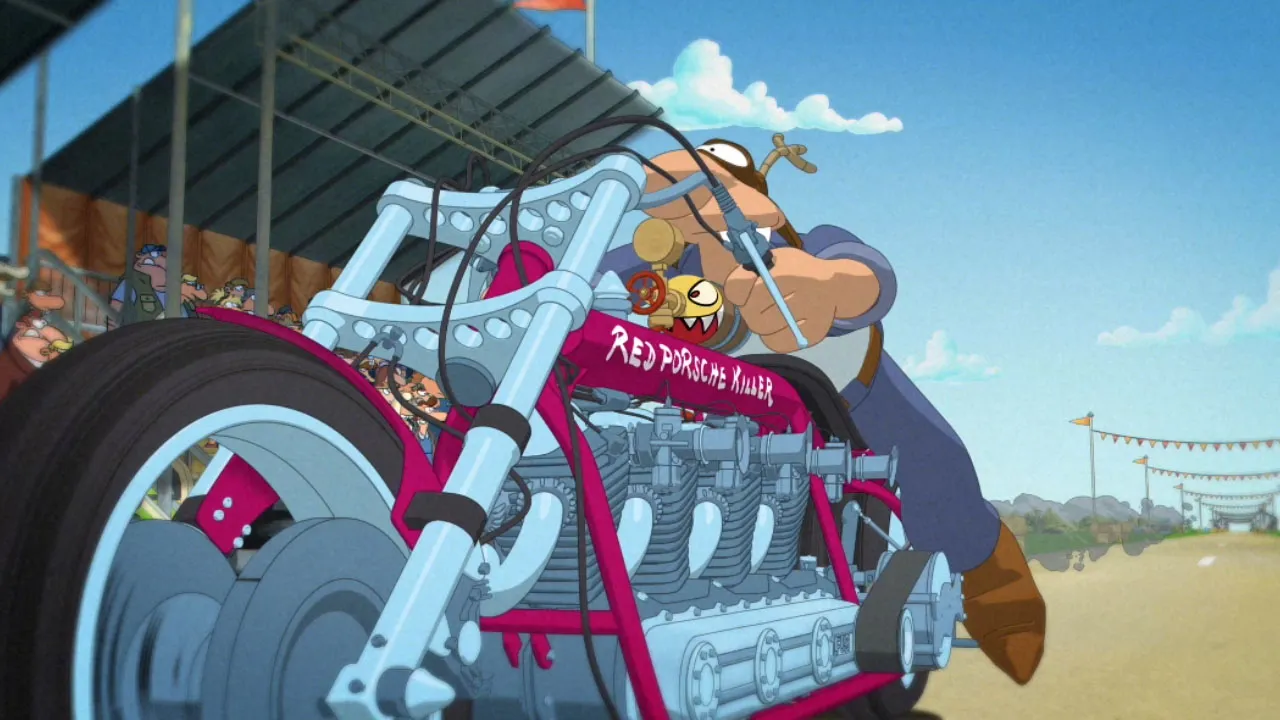
Whenever Brösel reminisces, the film cuts to fully animated Werner episodes featuring his illegally tuned motorcycles and his constant battles with the police.
When Brösel finishes his book and learns that audiences have abandoned the Werner comics for Japanese manga, he travels to Corsica in frustration, has a bathing accident and is presumed dead — triggering a huge "Werner" revival that his greedy publisher shamelessly exploits.
3D modeling (motorcycles incl. Red Porsche Killer, cars, police van, props like Bölkstoff bottle, sets, backgrounds) · 3D animation (vehicles, characters, backgrounds) · VFX (exhaust fumes, smoke, brake dust, tsunamis, flying transmission parts) · shading (2D cell-shaded for integration with 2D) · rendering of over 300 shots · Modeling, animation, VFX, shading, rendering
Constantin Film; TFC Trickompany Filmproduktion; MOOVIE the art of entertainment GmbH (Oliver Berben)
Constantin Film / Trickompany
Gernot Roll (live-action and lead direction); Rötger "Brösel" Feldmann (animation co-direction; additional directing per Letterboxd)
Rötger Feldmann (screenplay), Thomas Platt (screenplay), Herman Weigel (screenplay)
Producers: Herman Weigel (Constantin Film AG), Oliver Berben (MOOVIE — the
art of entertainment GmbH). Executive producers: Michael Schaack,
Martin Moszkowicz.
Cinematography: Gernot Roll. Editor: Melania Singer (with Sascha Wolff-Täger
per Filmdienst). Composer: J.P. Genkel. Production design: Florian Lutz.
Costume design: Gudrun Binger. Casting: Emrah Ertem. Camera operators:
Jürgen Hahn, Michael Praun. Lighting: Stefan Rentel, Harald Hauschildt.
Sound: Matthias Richter, Ulf Krueger, Sascha Heiny, Manfred Banach.
Visual effects: Frank Lenhard, Frank Govaere, Katja Müller (per Letterboxd
credits — confirms Pixable Studios' VFX involvement on the picture).
Live-action: Rötger Feldmann (Brösel), Ivonne Schönherr (Barbara),
Marysol Fernandez (Mandy), Richard Sammel (Hermann Seidel),
Kalle Haverland (Präsi), Andi Feldmann (Andi), Jochen Nickel (Herbert),
Michael Lott (Röhre), Thorsten Schütt (Walze), Holger Henze (Holgi),
with Horst Krause and Lilo Wanders in episode roles as Brösel's parents,
and Nicholas Bodeux as a publishing-house employee.
Voice cast: Klaus Büchner (Werner), Andi Feldmann (Andi / Meister Röhrich),
Bertram Hiese (Werner — 16 years), Janosch P. Agustin (Holgi — 16 years),
Benedikt Brandt (Klein-Holgi), Ingrit Dohse (Holgis Mutter), Robert Missler
(Schmittke), Kulle Westphal (Eckat), Lilo Wanders (Margret Röhrich, Frau Hansen).
German theatrical distribution: Constantin Film. Home video (DVD and Blu-ray):
Constantin (16:9, 1.85:1, DD5.1 / dts / dts-HD German audio).
lifelong friendship and rivalry · biker culture · illegally tuned motorcycles and run-ins with the police · Bölkstoff (beer) · the Hartenholm race · meta-narrative about the comic creator · 14 million-cinema-visitor cult comedy franchise
Pixable Studios contributed 3D modelling (motorcycles including the Red Porsche Killer, cars, the police van, props like the Bölkstoff bottle, sets and backgrounds), 3D animation (vehicles, characters, backgrounds), VFX (exhaust fumes, smoke, brake dust, tsunamis, flying transmission parts), 2D cell-shading to integrate the 3D layers with the film's traditional 2D animation, and rendering of over 300 shots.